

Via Mezzaterra
Last updated on September 8, 2026Overview
Via Mezzaterra is the spine of the old town of Feltre: a narrow, arcaded, climbing street running up from the Porta Imperiale to Piazza Maggiore.
What makes it worth walking is the painted facades. Feltre was burned in 1510 and rebuilt within a generation, and the sixteenth-century convention was to fresco the outside of a house. Here an unusual number of those frescoes survive.
Most Veneto towns had streets like this. Almost none still do -- exterior fresco is fragile, and four centuries of weather usually finish it.
Quick facts
- Type: Street/Avenue
- Local name: Via Mezzaterra (vedi la pagina italiana)
- Built: Rebuilt after 1510
- A street that kept its paint: Exterior fresco was standard across the sixteenth-century Veneto and has almost everywhere weathered away; Feltre’s survives in unusual numbers.
- Vittorino da Feltre: The humanist educator, born here in 1378, ran a school at Mantua that became one of the Renaissance’s most influential educational experiments.
Visit responsibly
The frescoes are the fragile thing here, and they are conserved at considerable expense. Do not touch the plaster, and do not lean against the painted walls.
These are people's houses. Photograph the facades, not through the windows, and keep noise down in a narrow street where sound carries.
Park below the old town and walk up. The street is not for cars, and the ones that do use it make the walk worse for everyone.
Feltre has little tourism, so spending in its shops and cafés matters more here than in a place that lives on visitors.
Where it is
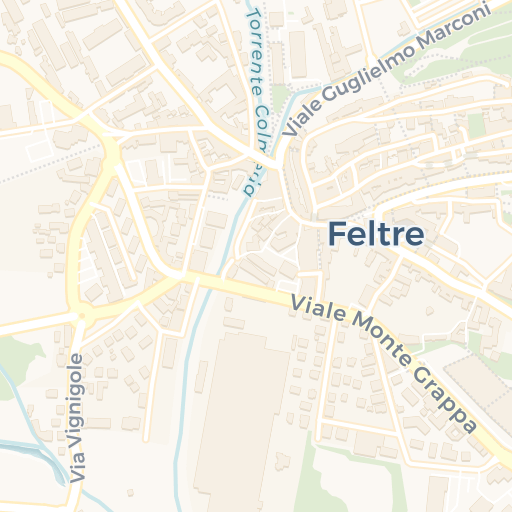
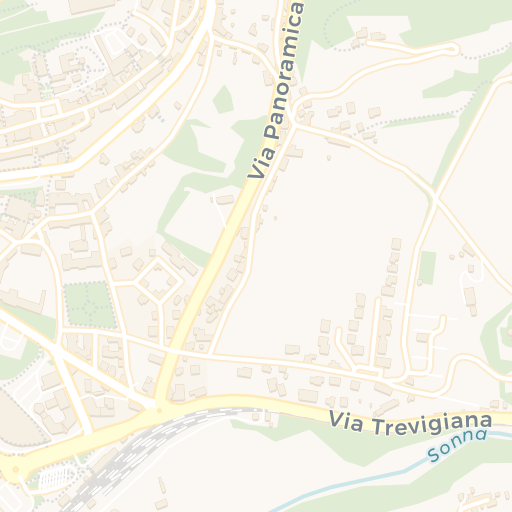
Get directions Open in Apple Maps
© OpenStreetMap contributors · © CARTO · 46.0175, 11.9081
Plan your visit
The street is free and always open, and pedestrianised.
Walk up from the Porta Imperiale to Piazza Maggiore -- about ten minutes at a steady climb, or half an hour looking properly at the facades.
Feltre's railway station, on the Padua-Belluno line, is about fifteen minutes' walk below.
The street is a continuous climb on cobbles, with steps in places. It is not accessible to wheelchairs, and is hard going with a pushchair.
Shops keep a long midday closure, when the street is quietest and best for looking at the buildings.
When to visit
Late afternoon is much the best -- raking light brings the frescoes out, and overhead midday sun flattens them into invisibility.
Spring and autumn are the pleasant seasons for the climb.
Early August brings the Palio di Feltre, when the street is dressed and busy -- atmospheric, but not the time to study facades.
Overcast days are surprisingly good for the paintings, giving even light without glare.